
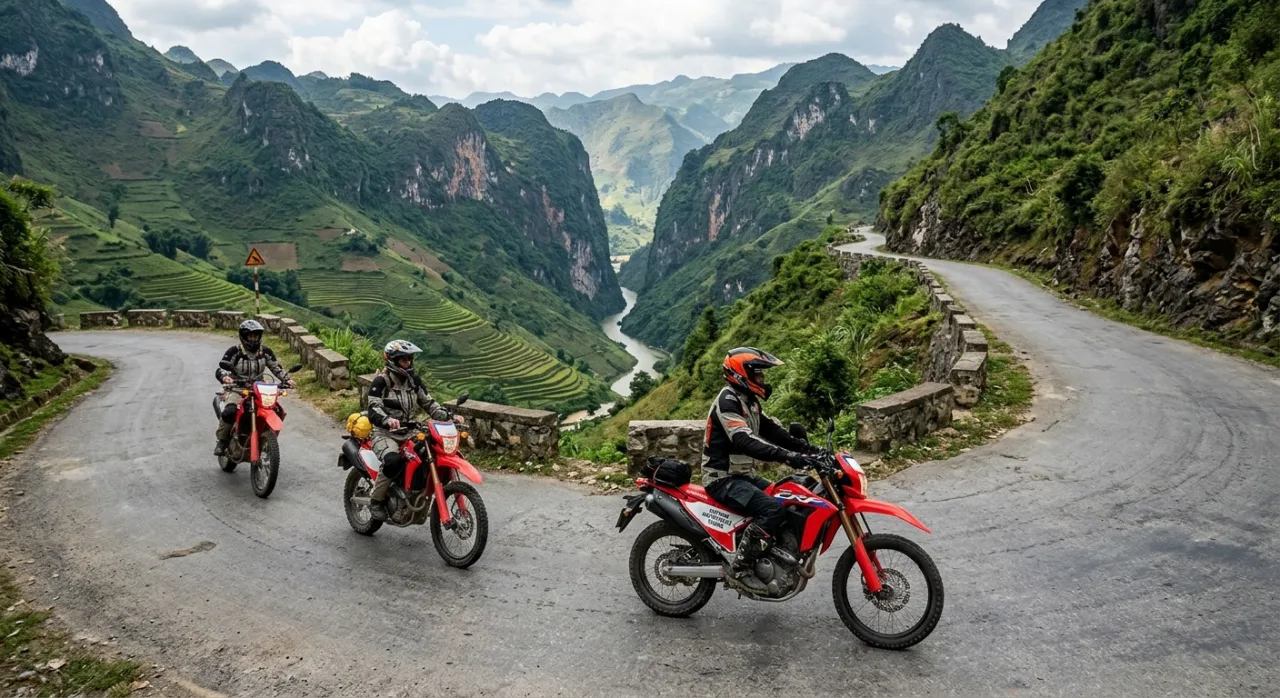
 Tearing through dramatic mountain passes, descending into ancient river valleys, and crossing remote highland villages offers an adrenaline-infused connection to Indochina that standard tours simply cannot match. With nearly three-quarters of the nation covered by rugged mountains, limestone karst formations, and tropical canopy, Vietnam is best explored on two wheels.
Whether carving through the legendary hairpin curves of the far north or navigating historic jungle paths along the Ho Chi Minh Highway, embarking on a guided motorcycle tour puts you directly in the heart of the action.
Why Explore Vietnam by Motorcycle?
Exploring Vietnam on a motorcycle grants absolute freedom and access to backcountry routes completely unreachable by tour buses.
-
Access to Secret Backcountry Trails: Reach remote alpine passes, unmapped logging tracks, and isolated villages far off the commercial tourist circuit.
-
Authentic Local Encounters: Connect directly with rural communities, staying in traditional ethnic minority homestays along the trail.
-
Stress-Free Navigation & Support: Ride behind expert local lead guides who handle real-time route changes, mechanical upkeep, and regional etiquette while a dedicated van transports your luggage.
Riding with a professional guide lets you focus entirely on throttle control, line selection, and taking in the breathtaking views as water buffalo plow terraced fields and wood smoke drifts from ancient timber stilt houses.
Key Riding Regions & Topography
Vietnam’s topography offers distinct terrain, weather, and riding challenges across every region:
1. The Jagged Northern Frontier
-
Key Locations: Ha Giang, Cao Bang, Sa Pa
-
Terrain: Technical alpine curves, steep switchbacks, and massive limestone gorges.
-
Must-Ride Passes: O Quy Ho Pass, Khau Pha Pass, and the jaw-dropping Ma Pi Leng Pass.
2. The Northwest Rice Terraces
-
Key Locations: Mu Cang Chai, Tu Le
-
Terrain: Smooth mountain tarmac sweeping into packed gravel, surrounded by golden-green terraced rice fields sculpted into sheer valley walls.
3. The Red-Dirt Central Highlands
-
Key Locations: Pleiku, Buon Ma Thuot, Lak Lake
-
Terrain: Rolling backroads, expansive tea and coffee plateaus, and flowing single-tracks with cooler mountain temperatures.
4. Historic Jungle Corridors
-
Key Locations: Phong Nha-Ke Bang, Khe Sanh
-
Terrain: The western Ho Chi Minh Highway features tight forest curves, karst mountain passes, and historic wartime landmarks buried in dense canopy.
-
Rider Tip: Looking to combine multi-day off-road riding with cultural stops? Check out our detailed guide on Ha Giang Loop Motorbike Itineraries to choose between 3-day and 5-day route options.
Machine Selection & Technical Breakdown
Selecting the right motorcycle is vital for safety and performance on Vietnam’s unpredictable terrain. While heavy adventure bikes struggle on narrow dirt tracks and slick clay, lightweight dual-sport motorcycles excel across all road conditions.
Honda CRF300L (286cc) Best for Technical Off-Road
-
Ideal For: Technical dirt climbs, rocky riverbeds, and broken terrain.
-
Key Advantages: Features long-travel suspension, high ground clearance, and a lightweight frame built to handle steep mountain trails effortlessly.
Honda CRF250L (250cc) Best for Mixed On-Road & Gravel
-
Ideal For: Intermediate to advanced riders tackling a blend of tarmac and off-road tracks.
-
Key Advantages: Proven long-distance reliability, smooth throttle response, and excellent balance across all surfaces.
Honda XR150L (149cc) Best for Beginners & Casual Riders
-
Ideal For: Newer off-road riders seeking a comfortable, forgiving machine.
-
Key Advantages: Low seat height, comfortable upright riding position, and smooth power delivery on mountain backroads.
Pillion Passenger Option Best for Non-Riders
-
Ideal For: Travel companions and photography enthusiasts who do not want to ride a motorcycle themselves.
-
Key Advantages: Sit back safely and comfortably behind an experienced local guide to experience the full journey hands-free.
Cultural Immersion: Authentic Village Homestays
The highlights of a motorcycle tour extend beyond the riding itself. By bypassing commercial resort corridors, tour routes connect you with remote mountain communities, including the Tay, Muong, H’mong, Red Dao, and White Thai ethnic minority groups.
-
Evening Arrival: Arrive at a traditional wooden stilt house after a full day on the trails and step straight into the authentic rhythm of rural life.
-
Communal Feasts: Gather around low tables for home-cooked meals prepared over open wood fires featuring mountain herbs, wild bamboo shoots, river fish, and cured pork.
-
Unfiltered Connections: Language barriers quickly disappear over warm hospitality, shared food, and traditional toasts of homemade rice wine.
Practical Preparation & Safety Essentials
To ensure a smooth and legal adventure on Vietnam’s roads, keep these essential requirements in mind:
-
Licensing & Documentation: Riders must hold a valid domestic motorcycle license along with an International Driving Permit (IDP) (1968 Convention). Ensure your medical travel insurance explicitly covers riding motorcycles above your bike’s displacement.
-
Support Logistics: Premium tours include a dedicated support vehicle to transport luggage, heavy tools, and spare parts. This keeps your bike light and responsive through tight technical sections.
-
Protective Riding Gear: Always wear full-face or adventure helmets, CE-armored jackets, abrasion-resistant pants, and sturdy off-road boots. Pack waterproof outer layers for sudden tropical downpours.
-
Trail Ethics: Stick to designated paths to prevent soil erosion, respect local village customs, always ask before taking photos of elders, and carry out all non-biodegradable waste.
For more advice on gear selection and local road regulations, explore our complete checklist for Vietnam Riding Gear and Legal Requirements.