
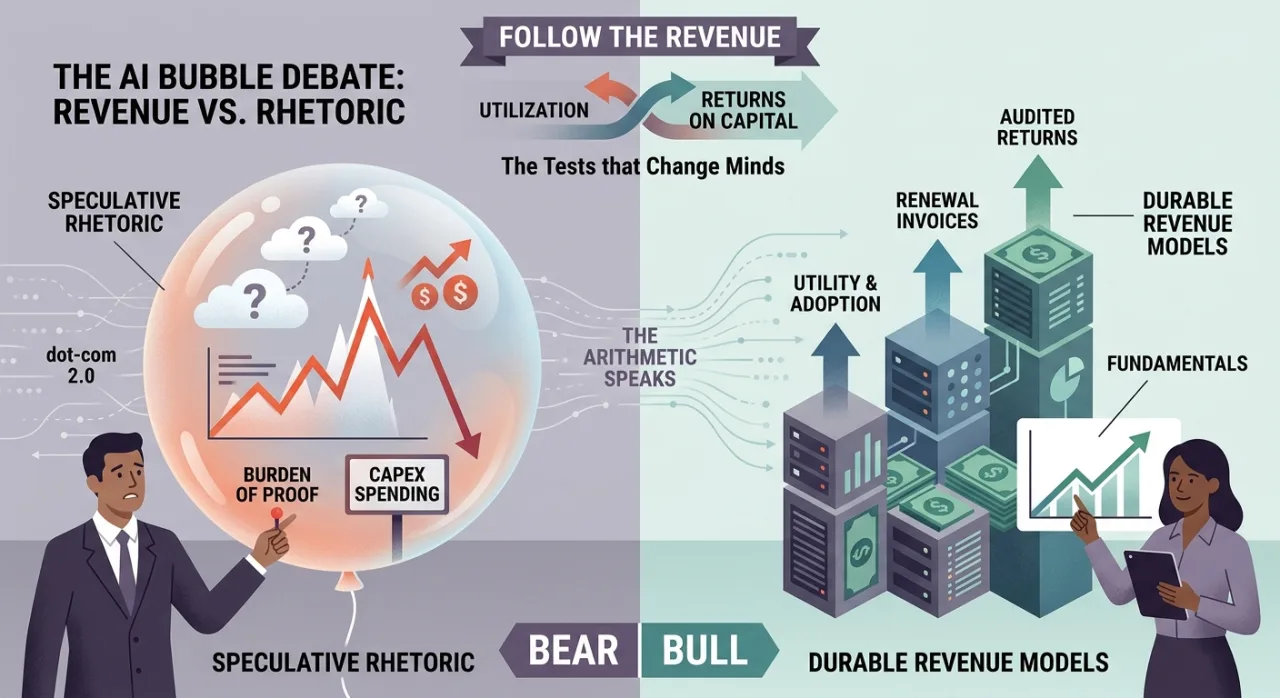
 The artificial intelligence debate has reached an impasse. For two years, bears have fixated on historic capital expenditure while bulls point to rapid enterprise adoption. Because both sides are answering fundamentally different questions, each routinely claims victory.
Resolving this debate requires moving beyond speculative rhetoric. The market needs concrete, verifiable benchmarks that either validate the historic capital outlay or confirm a speculative top.
1. Enterprise Revenue: Moving Beyond the Pilot Phase
Enterprise AI has generated thousands of trial deployments, but far fewer long-term contract renewals. The real evidence will appear in unglamorous financial reporting:
-
Key Metrics to Watch: Net dollar retention rates, expansion within existing accounts, and standalone AI revenue line items separated from core cloud platform growth.
-
The Test: When hyperscalers and software providers demonstrate that customers consistently spend more in year two than in year one at scale the bear case weakens significantly.
Consumer subscriptions tell a similar story. While free user adoption is massive, free services do not build a durable business model. Conversion rates to premium tiers and subscriber retention after promotional discounts expire will determine whether consumer AI is an essential utility or an expensive novelty.
2. Infrastructure Build-Out: Utilization vs. Circularity
The bears’ strongest argument centers on the sheer scale of capital spending on data centers and semiconductor hardware.
Cloud Provider Funding ──► AI Startup / Lab ──► Purchases Cloud Capacity
Critics argue that cloud providers funding AI labs which in turn buy computing capacity back from those same providers creates a circular revenue model reminiscent of dot-com era vendor financing.
To prove this spending represents foundational infrastructure rather than market mania, specific operational metrics must hold firm:
| Metric | Bull Signal | Bear Signal |
| Compute Capacity | Newly added data center capacity is rapidly absorbed | Empty data centers and idling GPU clusters |
| Rental Pricing | Compute rental pricing remains stable as supply expands | Severe price erosion due to oversupply |
| Depreciation Schedules | Hardware lifespan matches realistic audit schedules | Accelerating write-downs on obsolete hardware |
3. The Cold Arithmetic of Free Cash Flow
Ultimately, market sentiment is governed by financial returns. Historically, technology’s largest spenders earned exceptional returns on invested capital. If massive AI investments drag return metrics down without a clear revenue inflection, institutional shareholders will force a spending pullback regardless of technological promise.
The Lesson of 1999: The dot-com bubble was real, but so was the internet. Fiber optic networks laid in 1999 carried global web traffic for decades, yet many of the investors who paid for that infrastructure lost everything. Being right about a paradigm-shifting technology and being right about its investment timeline are two entirely different outcomes.
The Verdict: What Concession Looks Like
A clear resolution to the debate requires both sides to commit to measurable conditions:
-
Bears should concede if: Disclosed AI revenues and customer renewals compound year-over-year while compute capacity remains constrained.
-
Bulls should concede if: Capacity utilization drops, circular financing deals collapse, or flagship enterprise products fail to convert initial interest into sustained revenue.
The next four to six earnings cycles will yield definitive data in aggregate statistics specifically through cloud division margins, semiconductor shipment figures, and energy consumption across data-center regions. The bubble question will not be settled by louder arguments; it will be resolved line by line in audited financial reports.